After an initial hype on Capsule Networks in 2017, interest declined a bit and everyone was back to train bigger models or stripped models for mobile needs. However, preserving topology makes neural networks much smarter by using less training data. For this example, we’ll use a CapsNet implementation by XifengGuo that uses TF/Keras and see how it performs on KMNIST and K49.
KMNIST
This is straight forward. We have to change the load function in capsulenet.py from
def load_mnist():
    # the data, shuffled and split between train and test sets
    from keras.datasets import mnist
    (x_train, y_train), (x_test, y_test) = mnist.load_data()

    x_train = x_train.reshape(-1, 28, 28, 1).astype('float32') / 255.
    x_test = x_test.reshape(-1, 28, 28, 1).astype('float32') / 255.
    y_train = to_categorical(y_train.astype('float32'))
    y_test = to_categorical(y_test.astype('float32'))
return (x_train, y_train), (x_test, y_test)
to
def load_mnist():
    # the data, shuffled and split between train and test sets
	x_train = np.load("./Kuzushiji-MNIST/data/kmnist-train-imgs.npz")['arr_0']
	x_test = np.load("./Kuzushiji-MNIST/data/kmnist-test-imgs.npz")['arr_0']
	y_train = np.load("./Kuzushiji-MNIST/data/kmnist-train-labels.npz")['arr_0']
	y_test = np.load("./Kuzushiji-MNIST/data/kmnist-test-labels.npz")['arr_0']

	x_train = x_train.reshape(-1, 28, 28, 1).astype('float32') / 255.
	x_test = x_test.reshape(-1, 28, 28, 1).astype('float32') / 255.
	y_train = to_categorical(y_train.astype('float32'))
	y_test = to_categorical(y_test.astype('float32'))
	return (x_train, y_train), (x_test, y_test)
and we can run the basic CapsNet on this dataset.
This is no proper train-valid-test split!! However, it is enough to get a first impression of CapsNets on KMNIST.
I question the need of converting y_train/test to float32 before doing the one-hot-encoding.
Namespace(batch_size=100, debug=False, digit=5, epochs=50, lam_recon=0.392, lr=0.001, lr_decay=0.9, routings=3, save_dir='./result', shift_fraction=0.1, testing=False, weights=None)
__________________________________________________________________________________________________
Layer (type)                    Output Shape         Param #     Connected to
==================================================================================================
input_1 (InputLayer)            (None, 28, 28, 1)    0
__________________________________________________________________________________________________
conv1 (Conv2D)                  (None, 20, 20, 256)  20992       input_1[0][0]
__________________________________________________________________________________________________
primarycap_conv2d (Conv2D)      (None, 6, 6, 256)    5308672     conv1[0][0]
__________________________________________________________________________________________________
primarycap_reshape (Reshape)    (None, 1152, 8)      0           primarycap_conv2d[0][0]
__________________________________________________________________________________________________
primarycap_squash (Lambda)      (None, 1152, 8)      0           primarycap_reshape[0][0]
__________________________________________________________________________________________________
digitcaps (CapsuleLayer)        (None, 10, 16)       1474560     primarycap_squash[0][0]
__________________________________________________________________________________________________
input_2 (InputLayer)            (None, 10)           0
__________________________________________________________________________________________________
mask_1 (Mask)                   (None, 160)          0           digitcaps[0][0]
                                                                 input_2[0][0]
__________________________________________________________________________________________________
capsnet (Length)                (None, 10)           0           digitcaps[0][0]
__________________________________________________________________________________________________
decoder (Sequential)            (None, 28, 28, 1)    1411344     mask_1[0][0]
==================================================================================================
Total params: 8,215,568
Trainable params: 8,215,568
Non-trainable params: 0
...


Epoch 50

...

600/600 [==============================] - 531s 885ms/step - loss: 0.0435 - capsnet_loss: 0.0249 - decoder_loss: 0.0475 - capsnet_acc: 0.9783 - val_loss: 0.0762 - val_capsnet_loss: 0.0509 - val_decoder_loss: 0.0645 - val_capsnet_acc: 0.9472
We can see that KMNIST is much more challenging to all ML algorithms than MNIST. While it should take ~100-120 sec/Epoch to train this standard CapsNet example on MNIST, it takes ~ 8-9 min/Epoch on KMNIST.


K-49
Let’s keep it short. Running the CapsNet default structure on the K-49 datasets leads to training times of 2-2.5 h/epoch and it seems like it would require quite a lot of computation to build a useful model.
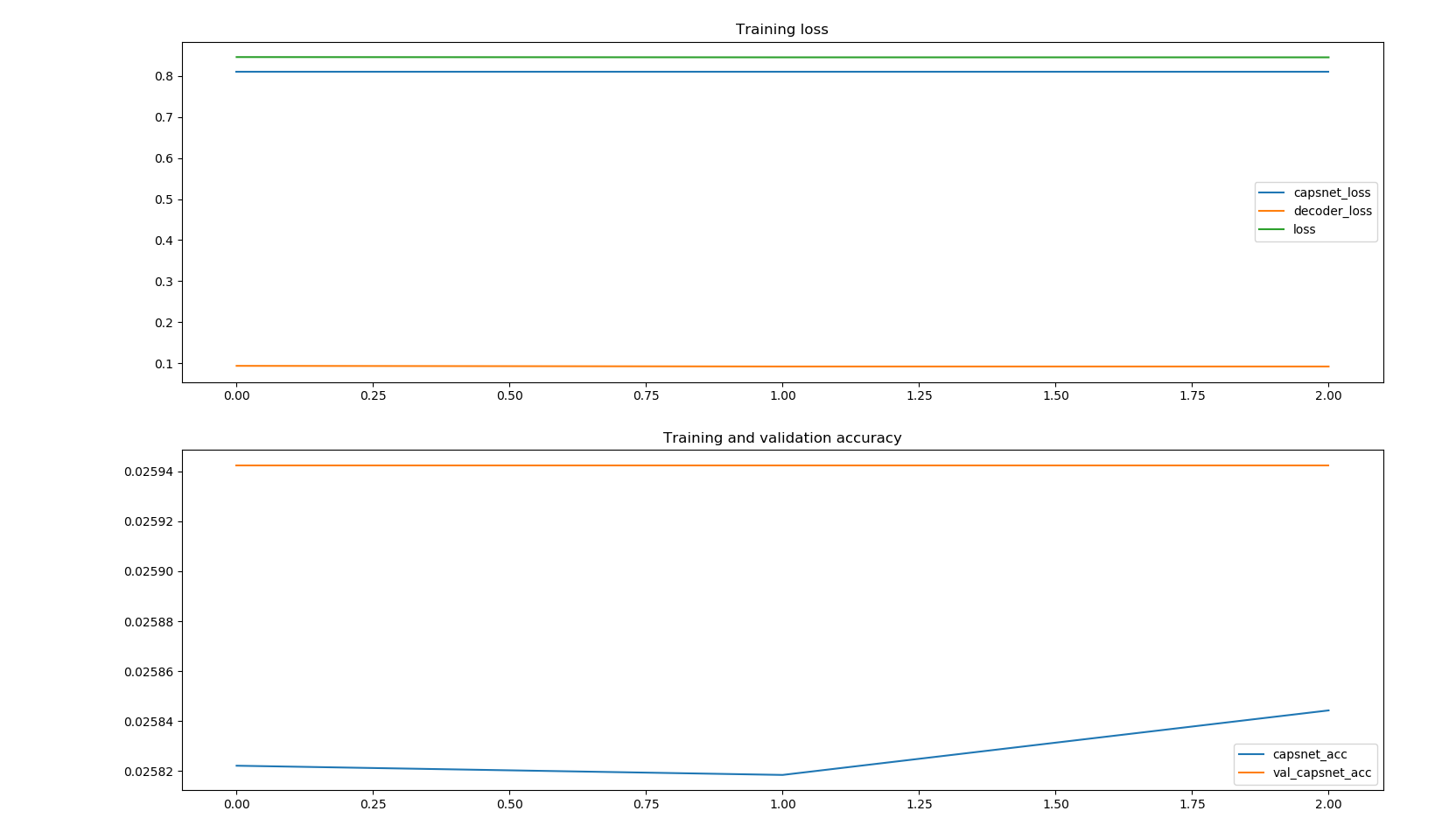
I am going to run this for 50 Epochs as well but only after improving the training process to reduce costs.